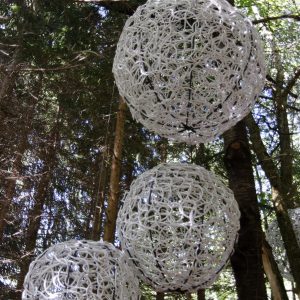
The Jardin des Cimes invites you to discover nature, the mountains, vegetable gardens, and the art of gardening during a one-hour stroll through some fifteen gardens and themed areas set within a 3-hectare park.
From a journey into the heart of the Alps to a tour of vegetable gardens from around the world and audio-guided walks through the peaks, this unique garden offers an exceptional view of the Mont Blanc massif along a path that is both sensory and educational.
The Grand Terrace
THE GRAND TERRACE is the heart of the garden. This space resembles a street that connects the ticket office, the Café du Jardin, the gift shop, the group reception area, and the amphitheater, which hosts cultural and educational programs. It evokes the human activity found throughout the valley.
A walk in the mountains
A visit to the Jardin des Cimes begins with an imaginary ascent from the valley floor up to the glaciers on the high peaks. The different aspects of life in the mountains are presented in a sensitive, artistic and educational manner.
LA PORTE DE L’OMBRE marks the start of the race, early in the morning, before sunrise. It is deliberately very shady, centred around a double tunnel of burnt wood covered in climbing plants. As you climb, listen carefully to the sounds around you: can you recognise the call of the black woodpecker, the pygmy owl or the hazel grouse?
LA PORTE D’OR is where the first rays of sunlight break through. The walk has begun and the landscape gradually takes on an orange hue, brightening as the sun rises. A play of light filters through the spruce trees, highlighting the last patches of mist.
This area is inspired by the subalpine zone. These are the last stretches of forest before reaching a higher, more rocky terrain. The contrast is striking between the damp gloom of the undergrowth and the bright, open space visible further up.
LA PORTE TELLURIQUE is a walk through a landscape of cairns, lapiaz and alpine plants. Cairns are piles of stones used as landmarks on mountain trails. Often precariously balanced, they are built using stones found on site and serve to mark a notable point or a fork in the path.
Lapiaz are limestone formations sculpted by water runoff. These formations are characteristic of the Platé Desert, which overlooks the Jardin des Cimes from an altitude of over 2,000 metres. Nestled within these stone channels and crevices are magnificent gardens of alpine plants.
LA PORTE DES ANGES is the garden’s highlight, offering a direct view of the Mont Blanc massif and its legendary summit, which rises to 4,810 metres. Come and experience a setting that recreates the high-mountain environment, from swirling winds to the sounds of glaciers. Explore a delicate landscape where nature is ever-present and, paradoxically, reduced to its most basic expression of power.
THE RAILWAY. From the Porte des Anges glacier, the trail winds its way down into the valley, passing through the railway area. This is a footbridge, built on a slope, which winds its way through the spruce trees. A display case halfway along the route shows visitors photographs of the construction of the Montenvert railway in the early 20th century.
LA PORTE DES MIROIRS is the small pond in the Jardin des Cimes. The pond is an ecosystem teeming with a wide variety of plant and animal life, and many species depend on these still waters to live, breed, feed or drink. Among the pond’s iconic species are the common frog and the common toad, newts, dragonflies such as the flat-backed dragonfly or the damselfly, other insects such as the backswimmer and the water strider, and reptiles such as the grass snake.
LA PORTE DU SOLEIL draws inspiration from the continuous human settlement in the Northern Alps, which, until the 19th century, was mainly concentrated on the sun-drenched slopes at altitudes of between 600 and 1,000 metres. Agropastoralism was then the main source of income. Hamlets and villages were established in areas sheltered from avalanches, on the poorest and least productive land. Gardens, orchards, vineyards and apiaries were situated nearby. Next came hay meadows and cereal cultivation on dry-stone terraces. Pastures were situated at higher altitudes, in the mountain and alpine pastures.
Gardens of the World
The return to the valley takes you along the bird hedge, and the gardens take centre stage through six ornamental gardens.
JARDIN CHROMATIQUE. From the Bronze Age onwards, and before the advent of synthetic dyes in the 19th century, textiles, basketry, paints and food were coloured exclusively using natural resources: plants, as well as insects, molluscs, lichens, fungi and minerals with colouring properties.
POTAGER ASIATIQUE. A large proportion of the vegetables we eat originate from the East. The spice route, stretching from China through Arabia, was also a route for vegetables. Whilst rice is the staple food in Asia, it is complemented by a wide variety of vegetables. What makes vegetable cultivation in China unique is the preservation of ancient varieties and the constant expansion of the range of vegetables through acclimatisation. Markets stock cabbages, but also cassava, bamboo shoots, sugar cane, soya beans, broad beans… making the Asian vegetable garden a highly diverse space.
INSULARITÉ. People living in the delta regions of major rivers were quick to take advantage of climatic variations to grow vegetables. A vegetable garden is an enclosed plot where water is a precious resource. Each growing bed is surrounded by a dyke. The vegetables grown include okra, sweet potato, taro and yam… In the Jardin des Cimes, insularity is represented by an exotic garden.
SAVOIR CLOS.Following the fall of Rome at the end of the 5th century, it was not until the *Capitulare de villis vel curtis imperii*, dating from the time of Charlemagne, that a list of plants and trees to be cultivated on the Empire’s farms was produced. It includes vegetables such as ‘greens’ and ‘grain vegetables’, considered more noble than ‘root vegetables’, as well as bulbs, fruit trees and vines.
The Kitchen Gardens
Located just below the Jardin des Cimes, beneath the Grande Terrasse and the Jardins du Monde, the kitchen gardens produce edible flowers, herbs, vegetables and fruit for the Café du Jardin and members of the Jardin des Cimes association.
THE COMMUNITY GARDEN is managed and run collectively by volunteers from the Jardin des Cimes association, with the aim of enhancing this 600m² space, turning it into a meeting place, growing a wide variety of plants, and experimenting with eco-friendly gardening practices. The community garden is open to all members of the association; everyone participates at their own pace and according to their availability, on Wednesday afternoons and Saturday mornings from mid-March to the end of October.
THE MARKET GARDENERS’ GARDEN. The market gardeners who tend this garden work by hand, using natural mulch (grass clippings, wool, twigs, leaves, etc.), manure and plant-based liquid fertilisers, whilst keeping watering to a minimum. Some of their seeds and all their seedlings are home-grown. The vegetables harvested are sold directly to the public, but they also supply the kitchen at the Café du Jardin.
THE SMALL ORCHARD. The Mont Blanc region boasts a rich heritage of fruit trees, including apple, pear, plum, quince, cherry, walnut and peach trees. In particular, there are several varieties specific to the region, such as the famous Passy prune, as well as the Blanchet pear (Saint Gervais), the Janin pear (Cordon) and others. Fruit consumption has become widespread in various culinary applications (dried fruit, stuffing, jams, etc.) and spirits (cider, liqueur, brandy).
SLOPING GARDENS. These sloping gardens demonstrate various methods of retaining soil. They are designed to supply the Café du Jardin and the shop with small harvests: edible flowers, herbs, plants for herbal teas, and so on.
X
Nous utilisons des cookies pour vous garantir la meilleure expérience sur notre site web. Si vous continuez à utiliser ce site, nous supposerons que vous en êtes satisfait.